mazegenerator is a small educational R package for generating, visualizing, animating, and solving rectangular mazes. It implements five generation algorithms — randomized depth-first search, Prim, Kruskal, Wilson, and Eller — and three pathfinding algorithms — A-star, Dijkstra, and breadth-first search — so their behaviour can be compared side by side.
📖 Documentation and gallery: https://matfmc.github.io/mazegenerator/
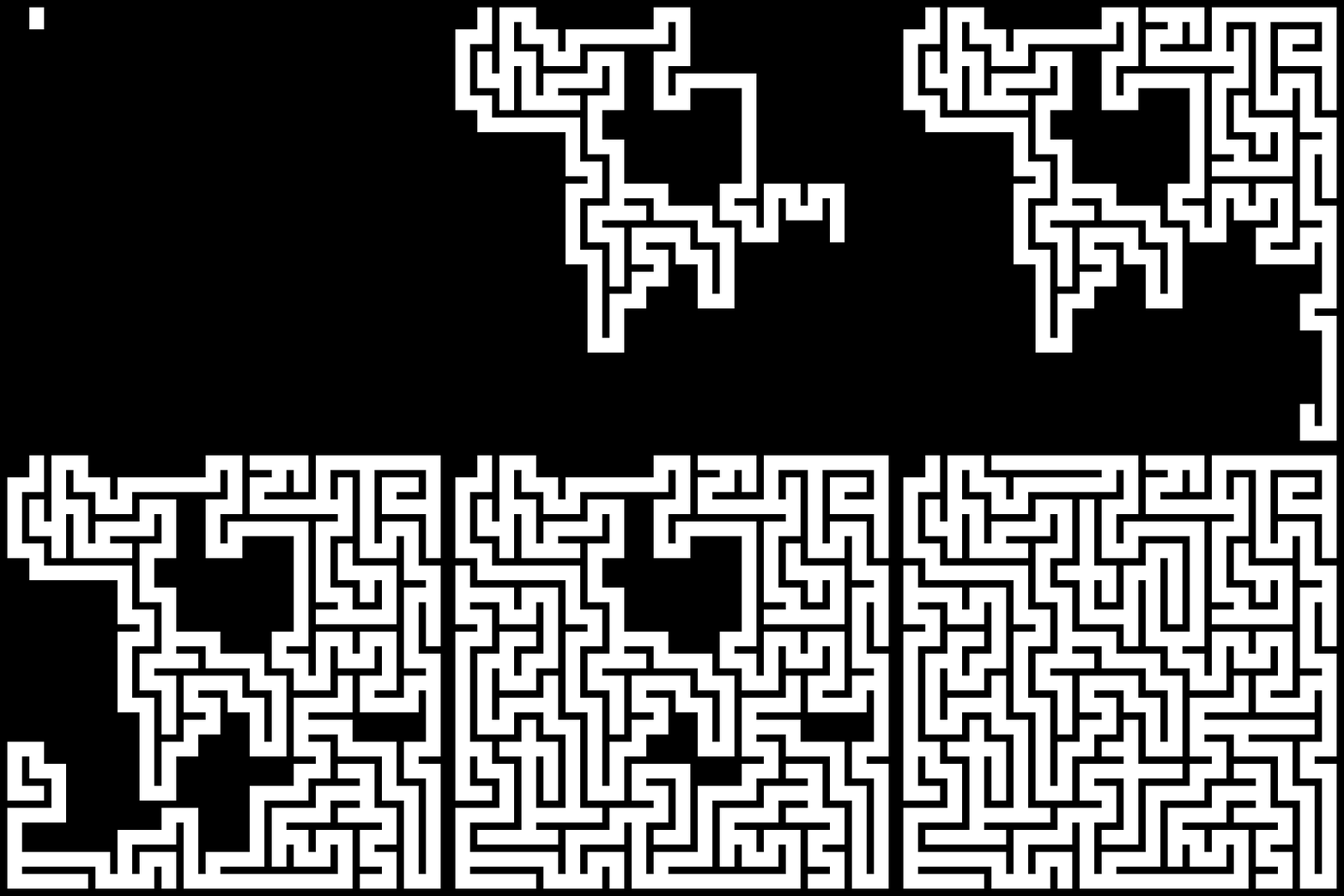
Gallery
Every generation algorithm carving the same 25 x 25 grid (seed = 42):
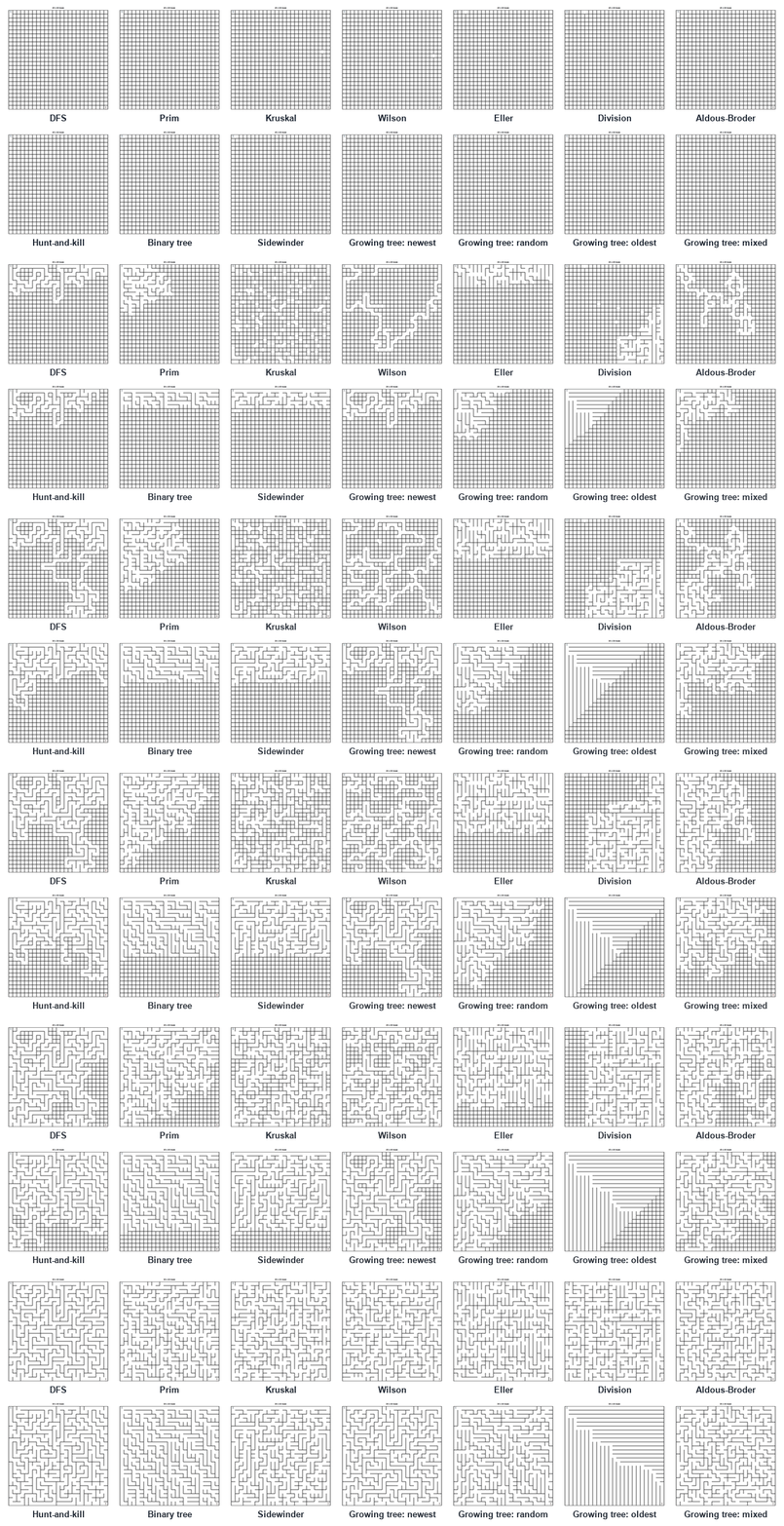
See each one up close, solved with A-star, in the gallery.
Installation
Install the development version from GitHub:
install.packages("remotes")
remotes::install_github("matfmc/mazegenerator")
The core package uses only base R. Animated GIF export additionally requires magick:
install.packages("magick")Generate and plot a maze
library(mazegenerator)

maze <- generate_maze(rows = 20, cols = 20, seed = 99)
plot_maze(maze)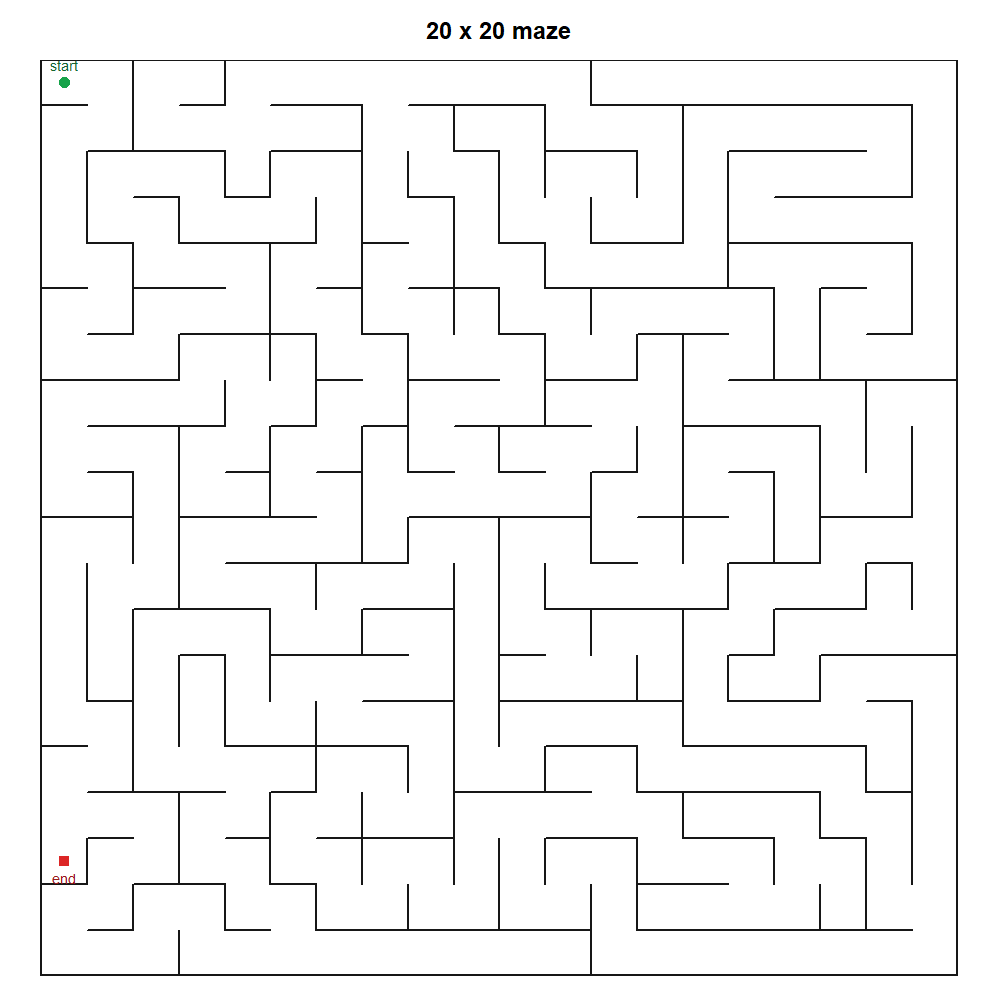
Generation is reproducible when seed is supplied. The returned maze object contains the passages carved between cells and carve_order, the order in which they were opened. Pick a different algorithm with algorithm:
plot_maze(generate_maze(20, 20, seed = 99, algorithm = "prim"))Each algorithm leaves a recognisable texture: depth-first search produces long winding corridors, Prim and Kruskal produce short bushy dead ends, Wilson draws uniformly from every possible maze, and Eller works one row at a time in constant memory.
Solve it
path <- solve_maze(maze)
plot_maze(maze, solution = path)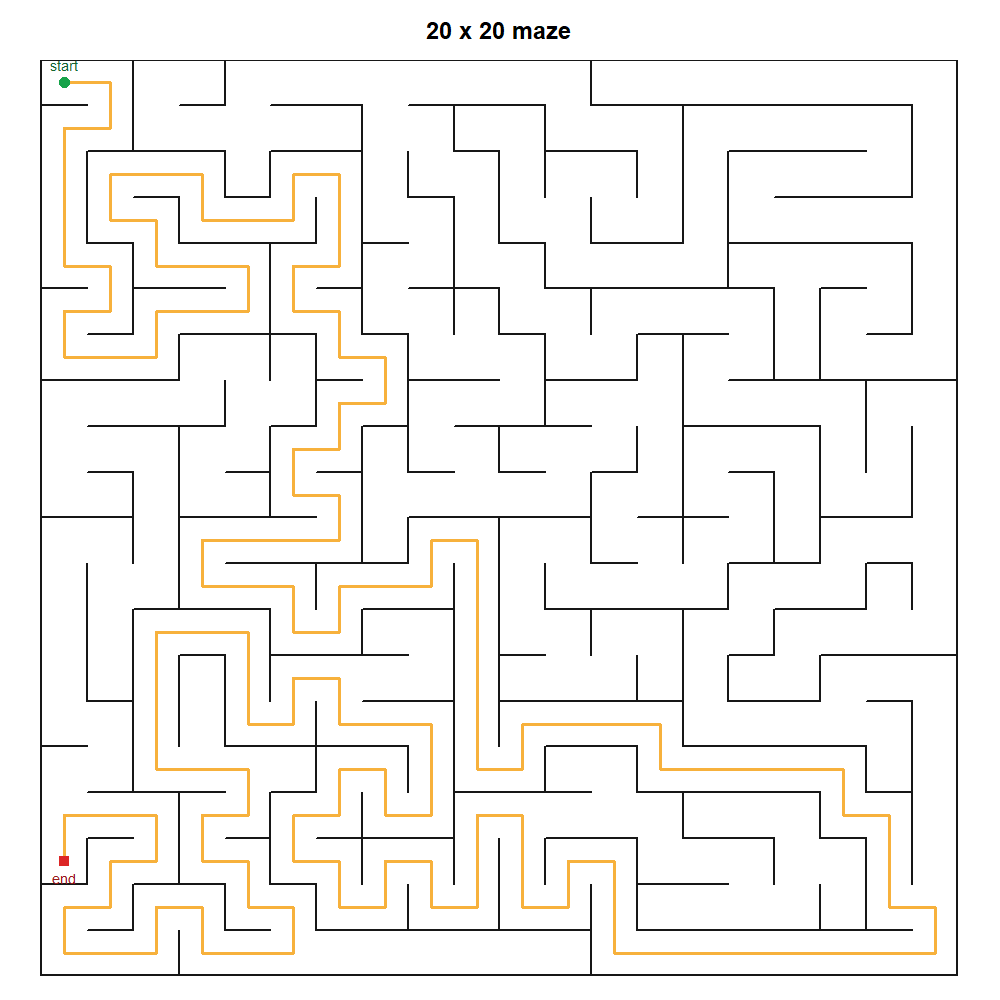
All three search algorithms return a shortest route; what differs is how much of the maze they expand to find it. trace = TRUE records every expansion:
maze <- generate_maze(40, 40, seed = 123, algorithm = "kruskal")

vapply(c("astar", "dijkstra", "bfs"), function(algo) {
  length(attr(solve_maze(maze, algorithm = algo, trace = TRUE), "search_trace")$steps)
}, integer(1))
#>    astar dijkstra      bfs
#>     1303     1600     1600
solve_maze() can also find a path through a numeric or logical matrix:
board <- matrix(
  c(1, 1, 0, 0,
    0, 1, 1, 0,
    0, 0, 1, 1,
    0, 0, 0, 1),
  nrow = 4,
  byrow = TRUE
)

solve_maze(board, start = c(1, 1), end = c(4, 4))
Animate the generation
small_maze <- generate_maze(12, 12, seed = 7)
animate_maze(small_maze, "maze-animation.gif", fps = 12)
For a large maze, use every to render fewer frames:
animate_maze(maze, "maze-animation.gif", every = 4)How it works
The generator starts in one cell and repeatedly chooses a random unvisited neighbor. When it reaches a dead end, it backtracks until another unvisited neighbor is available. This produces a perfect maze: all cells are connected and there is exactly one simple path between any two cells.
See the algorithm article for a visual explanation and the complete reproducible example.
License
MIT © 2026 Matheus. See LICENSE.md.